
In a business environment characterised by rapid change, unpredictable disruptions, and constant pressure to deliver, resilience is no longer a “nice to have” — it is a strategic imperative. For athletes, resilience is built through training, recovery and adaptation to pressure. For professionals and organisations, resilience training offers a pathway not only to cope with stress, but to bounce forward, adapt, and thrive.
Studies show that employees with higher resilience handle job strain better — they have lower rates of burnout, absenteeism and productivity loss. For example, a landmark analysis concluded that “workers with high resilience have better outcomes in difficult work environments.” Source 1 Source 2 Source 3
This article explores why resilience training is crucial in the modern workplace, what the evidence says, how to design effective programmes, and how you — as a professional or organisational leader — can implement resilience training to benefit both individuals and your business.
What is resilience — and why does it matter?
Defining workplace resilience
In organisational psychology, resilience refers to an individual’s capacity to withstand, adapt and recover from adversity, challenge or stress — and to maintain function, performance and wellbeing in the process. Source 4 Source 5 Importantly, resilience is trainable — not simply an innate trait.
The business case for resilience
High-strain work environments (e.g., high demands, low control, low support) are strongly linked with negative outcomes such as burnout, depression, absenteeism, and turnover. Source 6 Source 7 By contrast, research shows that resilience acts as a buffer — reducing the impact of job strain. For organisations, this means investment in resilience can lead to improved engagement, lower absence and stronger performance.
For example, one study found that organisational resilience and psychological resilience together impacted well-being, employee resilience and work engagement. Source 8 Another found a strong positive correlation between resilience at work and both job satisfaction and work engagement. Source 9
Why every workplace needs resilience training
Rising stress, complexity & disruption
Modern workplaces face more than just the usual deadlines and targets. Globalisation, digital transformation, hybrid work models, and fast-moving markets mean employees and leaders alike must adapt at speed. Organisations that have not built resilience into their culture risk being overwhelmed when disruption hits. McKinsey research suggests only a small percentage of global employers invest meaningfully in adaptability and resilience despite high need. Source 10 Preventing burnout and building sustainable performance
Burnout isn’t simply “too many hours” — it’s the result of sustained mismatch between demands and resources. When employees lack resilience, they are more vulnerable. A resilience training review concluded that programmes in organisational contexts “reported positive impacts on the mental health and subjective well-being of employees … some studies also reported positive changes in performance or other work-related benefits.” Source 11 Source 12
In other words: resilience training doesn’t just help wellbeing — it supports business outcomes.
Inclusion, equity & employee experience
Resilience training signals that organisations care about human capital, not just output. When employees feel supported, psychological safety increases, engagement improves, and the organisation can attract and retain talent more effectively. This is particularly relevant in corporate training and professional development contexts. Source 13
What does effective resilience training look like?
Key programme features identified by research
According to a scoping review of resilience training programmes in organisations, some critical characteristics emerged:
- Clear target groups and delivery mode (in-person vs. online) matter. Source 14 Source 15
- Blend of skills training (e.g., cognitive, emotional regulation) and environmental/organisational support.
- Ongoing reinforcement and integration into daily work culture.
- Delivery scalability and engagement were also important. Source 16 Source 17
Sample curriculum components for resilience training
Here’s a practical list of modules that work well in resilience programmes:
- Self-awareness & mindset: recognising stress responses, fixed-vs-growth mindset
- Emotional regulation & cognitive flexibility: breathing, pause/refocus, reframing
- Resource management & recovery: energy, sleep, micro-breaks
- Social resilience & support: building peer networks, psychological safety
- Organisational resilience alignment: role clarity, adaptive workflows, leadership modelling
Delivery models: hybrid, digital & embedded learning
With remote and hybrid work becoming common, many organisations offer resilience training via digital platforms. One pilot study of a mindfulness-based resilience programme delivered online showed feasibility in high-risk worker groups. Source 18 Another found that telephone/online coaching supported resilience development in organisational settings. Source 19
While digital delivery is convenient, the best programmes combine digital modules + live interaction + manager buy-in + ongoing reinforcement.
Implementation roadmap for organisations and professionals
Phase 1 — Assessment & alignment
How-to:
- Conduct a resilience audit: measure current resilience levels, stressors, and impact (use instruments like ADP’s Workplace Resilience Survey) Source 20
- Align training with strategic goals (e.g., improving agility, reducing turnover, enhancing leadership)
- Secure leadership sponsorship and embed metrics (engagement, absenteeism, performance)
Phase 2 — Design & pilot
How-to:
- Choose target groups (e.g., middle management, frontline teams, high-risk functions)
- Design training modules (see list above)
- Run a pilot (6-8 weeks), measure outcomes (resilience scores, stress indicators, performance)
- Collect feedback and refine
Phase 3 — Roll-out & embed
How-to:
- Scale the programme across the organisation, using blended delivery (online + live workshops)
- Integrate resilience into culture: managers model behaviours, include resilience in performance conversations
- Provide ongoing refreshers and micro-learning (e.g., monthly resilience check-ins, peer groups)
Phase 4 — Measure & iterate
How-to:
- Key metrics: resilience scale scores, employee wellbeing index, engagement, absenteeism, customer performance metrics
- Analyse correlations and ROI (e.g., fewer sick days, improved decision-making)
- Iterate content and delivery based on findings
Case study – real workplace impact
One organisation provided resilience training to high-strain teams, including modules on cognitive reframing, recovery routines and peer-support networks. Post-training, the organisation reported:
- A measurable increase in resilience scores
- A reduction in absenteeism
- Improved engagement and wellbeing
This aligns with research that resilience training leads to better outcomes even under high strain. Source 21 Source 22
Common challenges and how to overcome them
“We don’t have time for training”
Solution: Design micro-modules (15–30 minutes) that fit into the workflow. Research shows brief resilience trainings still produce benefits. Source 23
“How do we measure impact?”
Solution: Use both qualitative (employee feedback, interviews) and quantitative (resilience scores, engagement, performance metrics). Link training to business metrics (turnover, error rates). Leverage tools like the ADP Workplace Resilience Survey. Source 24 Source 25
“Training alone won’t fix structural issues”
Solution: Pair individual resilience training with organisational interventions (workload design, leadership practices, role clarity). Resilience is enhanced when the environment supports it. Research emphasises that organisational resilience mediates employee outcomes. Source 26
For professionals — how to develop your own resilience
If you’re an individual (athlete, business owner, manager) seeking to develop resilience, here are focused steps:
- Audit your stress systems: identify recurring stressors, your reactions, and recovery gaps.
- Build a resilience routine: daily micro-practices such as mindfulness, physical activity, structured reflection.
- Enhance your recovery skills: schedule breaks, manage sleep, unplug from work-life boundaries.
- Build your social support network: peers, mentor, coach. Resilience thrives in connection.
- Reflect & adapt: after each major challenge, ask: What worked? What didn’t? What will I do differently?
- Seek formal training/coaching: programmes and coaches significantly speed resilience development and embed skills.
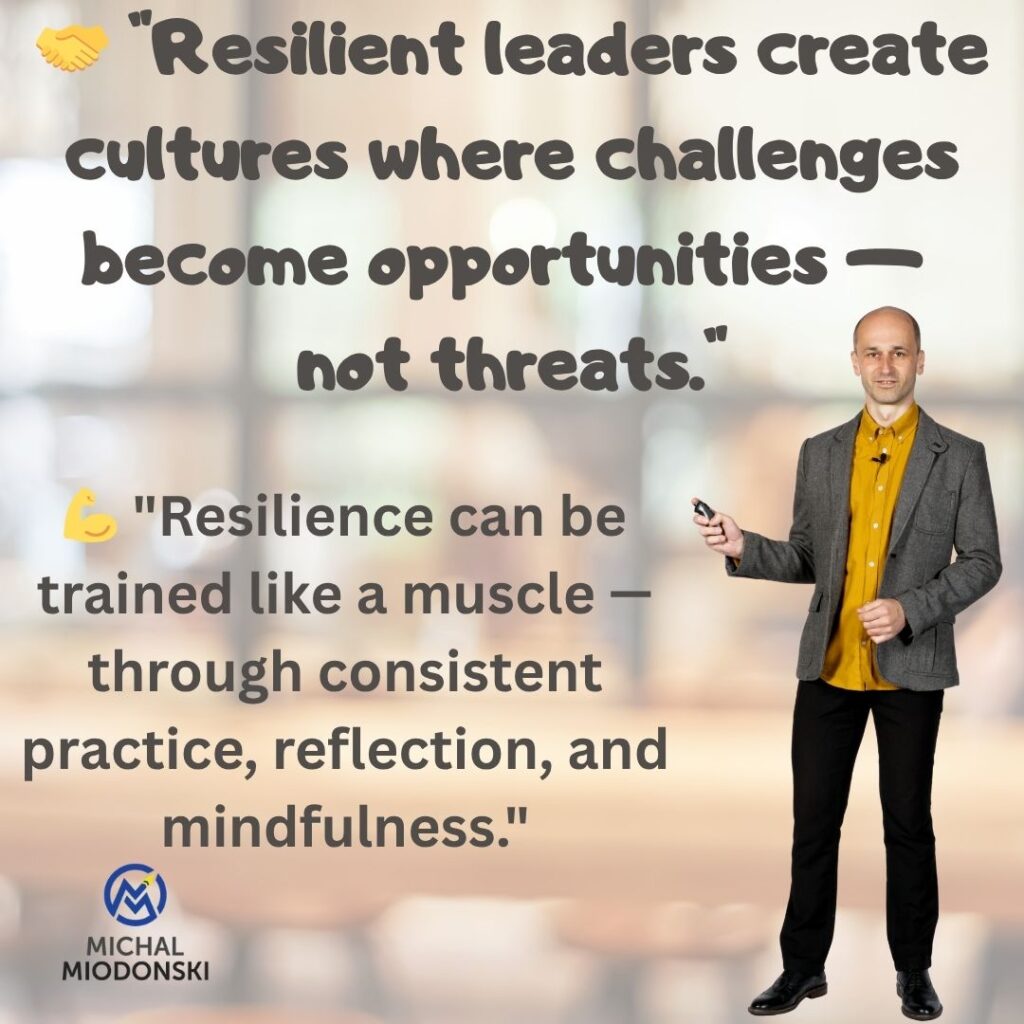
Conclusion
Workplaces today are dynamic, complex and high-pressure. Resilience is no longer optional — it is essential. Organisations that invest in resilience training equip their people not just to survive, but to thrive. Individuals who build resilience gain sustainable performance, wellbeing and adaptability.
Whether you are a senior leader orchestrating a large-scale training programme, a manager seeking to support your team, or a professional who wants to strengthen your ability to cope with and bounce from setbacks — resilience training offers practical, research-backed pathways to real impact.
Call to Action
If you’re ready to build resilience — at the individual or organisational level — I can help you.
I offer 1-to-1 coaching, online group trainings, corporate workshops & speaking engagements, and an online course “Mindfulness and Stress Management” which complements the resilience work beautifully.
👉 Contact me today to explore how we can customise a resilience training programme for you or your team and create lasting impact.