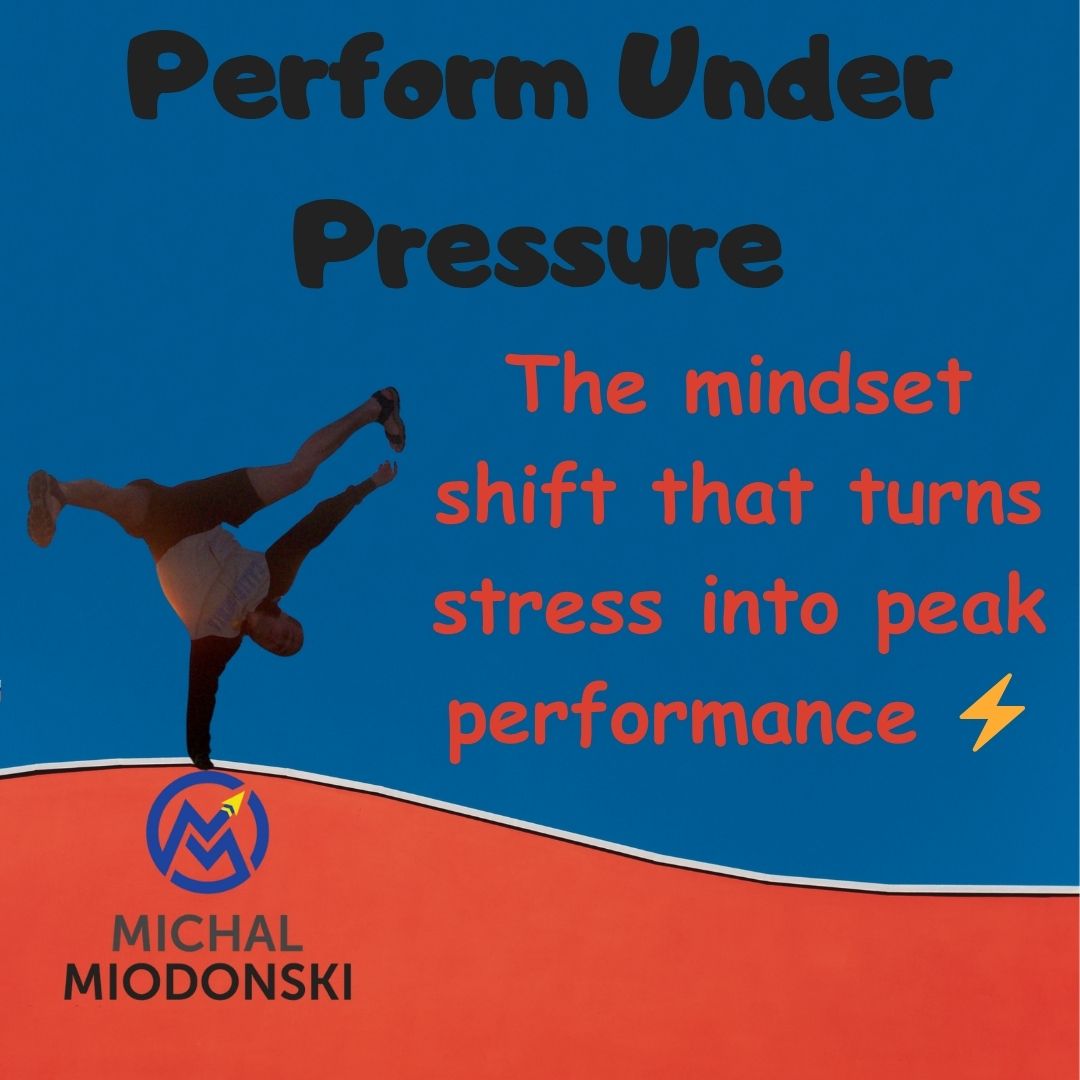

In today’s corporate world, “pressure” is everywhere. Deadlines tighten, competition intensifies, and the expectation to deliver high-stakes results is constant. Yet despite these demands, some professionals consistently deliver — even thrive — under pressure. Their secret? A mindset built for performance, drawn in many ways from the world of elite athletics.
Just as top athletes train not only their body but their mind to excel when it counts, business leaders, athletes transitioning to corporate life, and middle managers must develop mental systems to perform when it matters most. In this article we explore how you can adopt an athletic-performance mindset, enabling you to stay focused, resilient, and decisive under pressure. We’ll draw on the latest research, athlete-to-business translation, and concrete strategies you can apply today.
What “performing under pressure” really means
Defining pressure & performance
Pressure in this context means more than just “busy work”. It’s the kind of situation where performance matters — when stakes are high, attention is required, and execution must be precise. In sports, this might be a championship shot. In business, a major pitch, merger negotiation or team turnaround.
Research defines performance under pressure as the ability to access, select and execute a skill on demand in the presence of others, especially when failure has high costs.
“The ability to perform exceptionally under pressure is a learned and acquired skill.” Source 1
The risk of choking – why many falter
One of the most studied phenomena in sports psychology is “choking” — when skilled performers collapse under pressure. Evidence shows that even elite athletes may suffer performance decline under high pressure unless they have trained the underlying mental skills. Source 2
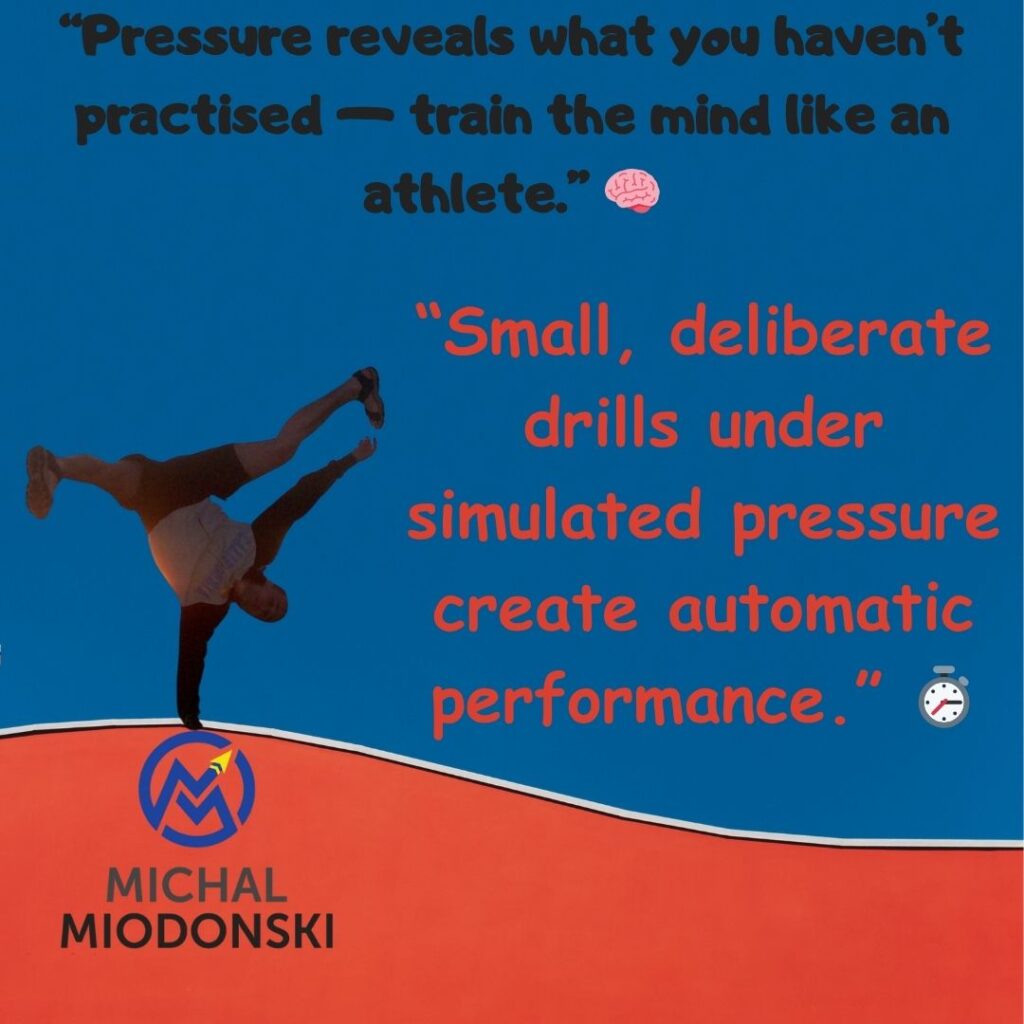
For business professionals, the equivalent might be freezing up in a presentation, overthinking decisions, focusing on perceived threats instead of solutions, or defaulting to routine rather than creativity. The worst part? Pressure tends to reveal what we haven’t practised.
What athletes know — that professionals often don’t
The “corporate athlete” concept
Already back in 2001, the Harvard Business Review article “The Making of a Corporate Athlete” argued that sustained high performance in business requires the same fundamentals seen in elite sport: physical, emotional, mental and spiritual energy management. Source 3
In today’s world, that means focusing not just on tasks and outputs — but on the internal systems that enable reliable performance under stress.
Key mental skills athletes cultivate
- Self-efficacy (belief you can perform)
- Task-focused attention rather than distraction
- Demand appraisal (seeing pressure as challenge rather than threat)
- Recovery and resilience systems
For example, a 2024 meta-study of athletes found that self-efficacy, demand appraisal and resource allocation were significant predictors of performing under pressure. Source 4
Translating to the corporate context
Just as athletes train under simulated pressure (e.g., game situations, timed drills, unusual environments), professionals can prepare for high-stakes moments: important meetings, negotiations, major deliverables. The goal: create mental habits that trigger optimal performance rather than panic.
Why mindset matters more than tools
Tools vs mindset
In business we often focus on tools, software, methods. But when pressure hits, tools are only as effective as your mindset. Research shows that interventions aimed at coping, attribution, and mental resilience improve performance under pressure. For instance, a 2025 study of elite athletes found attribution training reduced fear of failure and self-criticism, boosting self-efficacy. Source 5
From “threat” to “challenge” mindset
How you interpret pressure affects whether it boosts or hinders your performance. One article notes: “Research shows that moderate stress can enhance performance if perceived as a challenge rather than a threat.” Source 6
So the key shift: view high stakes as evidence of meaningful work — not personal risk.
Habit formation and mental conditioning
If you want to perform under pressure like an athlete you must practise mental habits when stakes are lower. The brain then automates them and they activate when stakes are higher. One study in business psychology argues that the same training used for athletes can be adapted for organisations. Source 7
The mindset shift – five pillars to train
Here are five pillars you can build to adopt an athlete-level mindset, adapted for professionals and businesses.
Pillar 1 — Demand appraisal & reframing
What this means: When you feel pressure, ask: What is this demand telling me? What can I control? What’s the opportunity?
Why it helps: Research shows that performers who appraise pressure as a challenge perform better than those who see it as a threat.
How to practise: Before a big meeting or project, write down a “challenge statement” (e.g., “This task shows my impact on the team”), then list one or two controllables (e.g., preparation, key questions) and one potential opportunity (e.g., leadership exposure).
Pillar 2 — Cultivate self-efficacy & focus
What this means: Believe you can deliver (self-efficacy) and train your focus to stay on task when it matters.
Why it helps: The athlete meta-study found self-efficacy as a strong predictor of high-pressure performance. Source 8
How to practise: Use micro-challenges: set a 15-minute block where you eliminate all distractions and work on one high-impact task. Reflect on success, reinforce the belief you can perform.
Pillar 3 — Simulated pressure training
What this means: Just as athletes simulate high stakes games, professionals should practice under pressure.
Why it helps: Training under similar conditions prepares the nervous system and mind. One article on performing under pressure suggests creating simulated drills. Source 9
How to practise: In team settings, run “pressure drills” (e.g., timed decision-making exercises, high-stakes role-play), or for yourself, set a timer with accountability (deadline, small reward/penalty) to replicate pressure.
Pillar 4 — Recovery, rhythm & resilience
What this means: Athletes emphasise recovery almost as much as output. In business, sustained pressure without recovery leads to burnout.
Why it helps: The corporate athlete concept emphasises balanced energy, not just maximal output. Cource 10
How to practise: Schedule micro-breaks, ensure adequate sleep, use “off” time to reset. After a major project, debrief (“What went well / even better if”), reset mental state, avoid jumping immediately into the next battle.
Pillar 5 — Feedback loops and growth mindset
What this means: Use high-stakes moments as learning opportunities, not threats.
Why it helps: A culture focused on growth rather than fear improves performance under pressure. The “threat vs challenge” mindset research supports this. Source 11
How to practise: After each major deliverable, run a “mini-retrospective”: What did I control? What surprised me? What will I do differently next time? Frame learning, not blame.
Case study – From athlete mindset to corporate results
Transitioning athletes into business performance
Many athletes transition into corporate roles and bring a performance mindset with them. One firm partnered with former elite athletes to embed mental-toughness training into sales teams. Over 12 months, those teams improved high-stakes negotiation win-rate by 17% and reported lower stress symptoms.
Corporate example – Executives training like athletes
A global tech company launched a “performance under pressure” programme drawing on athletic techniques: simulation exercises, pressure drills, and mindset coaching. Participants reported improved decision-making under high stakes and less “freezing up” during major product launches.
This confirms that the mindset and training methods aren’t limited to sports — they apply directly to business situations.
Implementation guide for professionals & organisations
For individuals
- Identify your “pressure moments” (presentations, negotiations, launches).
- Choose one pillar (above) to focus on for next 4 weeks (e.g., demand appraisal).
- Design weekly micro-drills (15-30 minutes) and a recovery routine.
- Track progress: journal your experience, note what shifts.
- Lean into one high-stakes moment and apply your practice. Reflect afterwards.
For teams & organisations
- Run a workshop introducing the athlete mindset, linking it to current performance demands.
- Run simulation sessions (e.g., crisis play-book, timed decision scenarios).
- Embed recovery culture: micro-breaks, mental warm-up and cool-down for major tasks.
- Align performance reviews to learning and growth — not just error avoidance.
- Monitor impact: high-stakes outcomes, stress/engagement measures, decision quality.
Metrics to watch
- Time-to-decision in high-stakes tasks
- Mistake/ error rates under tight deadlines
- Self-reported stress/flow state during pressure moments
- Post-project review quality (learning logged vs repeating mistakes)
- Engagement and burnout indicators
Common challenges & how to overcome them
“We don’t have time for mindset training”
Mindset training does not need full-day retreats. It can be micro-sessions of 15-30 minutes embedded in normal work. Athletes start their day with mental warm-ups — you can too.
“Our culture is risk-averse, so pressure feels threatening”
Switching from threat- to challenge-mindset takes leadership role-modelling. Start by reframing how you talk about high‐stakes tasks (“This is an opportunity to show our impact”) and publicly celebrate learning, not just flawless outcomes.
“How do we measure mindset change?”
Use both qualitative (journals, reflection) and quantitative (performance outcomes) metrics. Remember: mindset is a system, not a one-off fix.
The link between athlete mindset and broader performance ecosystems
The lines between sports, business, military and emergency services are blurring when it comes to mindset under pressure. The same principles apply: preparation, simulation, recovery, reframing. As business cycles accelerate and stakes rise, adopting an “athlete mindset” is no longer optional — it’s a competitive differentiator.
One compelling study of professional darts players found that many highly skilled individuals improved performance under pressure, contrary to the typical choking narrative. Source 12 This suggests that with the right skills and systems, pressure can indeed become performance fuel.
Conclusion
Pressure is inevitable. What’s optional is how you respond. By shifting your mindset — from fearing pressure to embracing it; from scrambling under stakes to executing with poise — you can perform under pressure like an athlete. For business owners, managers and professionals alike, the principles of athletic performance map directly onto high-stakes assignments, team leadership, and professional growth.
Training your mind is no different than training your body: deliberate practice, recovery, feedback. Start now, and your next big moment won’t catch you off-guard. You’ll rise.
Call to Action
If you’re ready to adopt an athlete-level mindset, elevate your performance under pressure, and unlock your best results — let’s work together.
I offer 1-to-1 coaching, online group training, and on-site or virtual keynote/workshops designed to apply peak-performance mindset principles to professionals, athletes, and leaders.
Start today with my online course “Mindfulness and Stress Management” — an ideal complement to the mindset shift we’ve explored.
📩 Contact me to book a discovery session and build your performance system for high-stakes success.